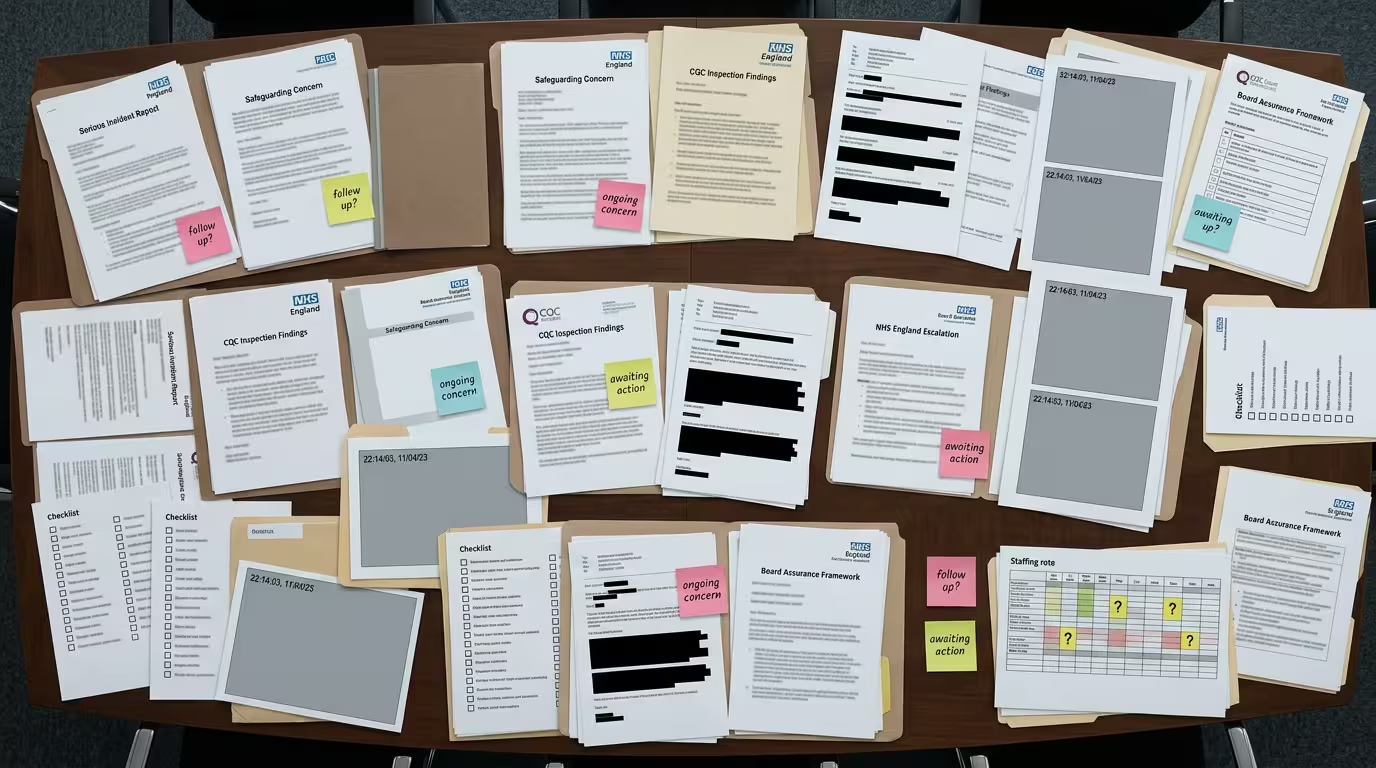
Not every governance question needs a long report. Sometimes the most useful starting point is a shorter outside-in reading that helps clarify what is publicly visible, where the picture looks stable, and where closer attention may be needed. That is where a Signal Snapshot can be useful.
But a shorter review is only useful if it fits the question being asked. If the issue is narrow, early-stage, or still poorly defined, a Signal Snapshot may be enough to orient attention. If the picture is already more complex, more sensitive, or more structurally uneven, a deeper review may be the better choice from the start.
What a Signal Snapshot is designed to do
A Signal Snapshot is designed to provide a focused outside-in reading of public information within a limited scope. It is not intended to settle every question. Its job is to give a clearer first view of the visible public footprint around a provider, service, or location.
That usually means reading across a defined set of public signals, identifying notable patterns or inconsistencies, and turning them into a short written output that helps decision-makers see what may need closer internal attention. The value lies in clarity, speed, and proportion. It is a first structured read, not an attempt to turn a limited scope into a full organisational picture.
What it can do well
Used properly, a Signal Snapshot can do several things well.
- It can make a diffuse public picture easier to read, especially where the issue is currently vague or spread across several visible signals.
- It can help surface visible tensions early, before they are fully named or fully understood internally.
- It can support prioritisation, by showing which parts of the public picture appear broadly settled and which look more uneven.
- It can improve the quality of internal discussion, especially when leadership needs a more grounded starting point rather than a full-scale review.
Its strength is that it stays within its limits. It does not try to do the job of a deeper review. It helps leaders decide what kind of question they are really dealing with.
When a Signal Snapshot is enough
A Signal Snapshot is often enough when the goal is orientation rather than deep evaluation. It works best where leadership wants a clearer reading of public signals without yet needing a broader or more layered external assessment.
That may include situations such as:
- an early-stage concern, where something feels slightly uneven from the outside but the issue is not yet clearly defined
- a specific location or service question, where the scope is narrow and the aim is to understand the visible public picture around that part of the organisation
- a short decision window, where leadership needs a more structured first read before deciding whether deeper work is justified
- a need for prioritisation, where several possible concerns exist and the immediate question is where closer attention may be most useful
- a board or senior team discussion, where a concise outside-in briefing may sharpen questions without overcomplicating the conversation
In these settings, a shorter review can be the right level of intervention. It gives enough external structure to be useful without pretending to answer more than the evidence can support.
When it is not enough
A Signal Snapshot is not the right tool for every situation. If the question is already more complex, or if the visible public picture appears structurally uneven across multiple areas, a shorter output may leave too much unresolved.
A deeper review is usually more appropriate when:
- the issue spans multiple locations, entities, or leadership layers, and the public picture needs to be read at more than one level
- the visible signals are already dense or conflicting, making a short first read too narrow to do the situation justice
- the stakes are higher, especially where the external picture may carry stronger governance, reputational, or strategic implications
- the aim is comparison or pattern analysis across a wider group, rather than understanding one defined area
- leadership already knows there is a broader question, and the real need is structured depth rather than initial orientation
In those cases, the risk is not that a Signal Snapshot would be wrong. The risk is that it would be too slight. A shorter review can clarify a narrow issue, but it should not be stretched beyond the level it was designed for.
Why choosing the right depth matters
Choosing between a Signal Snapshot and a deeper review is really a question about fit. A shorter review is most useful when it helps simplify an uncertain public picture. A deeper review is more useful when simplification would hide too much of the structure that actually matters.
This matters because external review is only useful when the output matches the problem. If the work is too light, the organisation is left with a partial answer to a broad question. If it is too heavy, time and attention may be spent before the issue has even been properly framed. The better choice is the one that gives the clearest decision-useful picture at the right level.
What question to ask before choosing
A practical way to decide is to ask one simple question first: are we trying to get a clearer first reading, or are we trying to understand a more developed pattern?
If the need is a clearer first reading, a Signal Snapshot may be enough. If the need is to understand how multiple signals, locations, or layers fit together over a wider picture, that points more naturally towards deeper work.
The difference matters because outside-in work is not only about what is visible. It is also about how much visible complexity needs to be held together in one reading.
In practice
Pattern Scope uses Signal Snapshots as focused first reads. They are designed to help decision-makers get a clearer view of publicly visible signals without overstating what a shorter review can settle. Where that level is enough, the result can be practical, efficient, and useful for prioritisation.
Where the visible picture is broader, denser, or more uneven, a deeper review is often the more honest starting point. The aim is not to push every question towards more work. It is to match the scope of the review to the shape of the question, so that the output is clear enough to help and proportionate enough to trust.
Pass on the canonical article link in the format people already use.
Get alerts on this device when new writing lands.
Turn on browser notifications for fresh articles and high-signal editorial drops. On iPhone or iPad, install the app to the Home Screen first.
No inbox clutter. This browser or installed web app becomes the endpoint.
Recommended next step
Need the service-level version of this choice?
Use the dedicated comparison page when the real task is choosing the right snapshot level, not reading the longer explainer.