St Andrew’s Healthcare Northampton is no longer only a story about abuse allegations inside one troubled institution. It is also a case study in how repeated warning can fail to become timely protection.
In March 2026, NHS England told commissioners to begin identifying alternative placements for all NHS patients receiving inpatient care at the Northampton site. The reason was stark. After earlier enforcement action, NHS England said it still did not have adequate assurance that patient safety was improving at the pace required. An enhanced 24/7 NHS oversight team was placed on site while the transition process began.
That matters because by this point the issue no longer looked like sudden collapse. It looked like prolonged regulatory deterioration.
The Care Quality Commission had already identified serious concerns across multiple inspections. By December 2025, the overall rating for St Andrew’s Northampton remained inadequate, the service stayed in special measures, and CQC identified 14 breaches of regulation linked to person centred care, safe care and treatment, safeguarding, dignity and respect, good governance, and staffing. The regulator also said improvements had not been made despite earlier findings, and pointed to closed cultures, unsafe care, and people remaining at risk.
Why this does not look like sudden collapse
The most important point in this case is that the warning signs were not new. This was not a single shock event followed by immediate system response. It was a pattern of repeated concern, incomplete correction, and delayed intervention.
That matters because institutions rarely fail in public all at once. More often, they fail through accumulation. Concerns are raised. Improvement plans are written. Oversight intensifies. Leaders promise correction. But the underlying risk picture remains unstable, and the protective response arrives later than it should.
By the time NHS England moved to support the relocation of 287 inpatients, the central issue was no longer whether concerns existed. It was whether the system had acted early enough to protect people from prolonged exposure to those concerns.
Why this matters in specialist settings
This case becomes even more serious because of the patient population involved. Specialist mental health, acquired brain injury, learning disability, autism, and forensic settings carry a different governance burden from ordinary service environments.
Some patients may be less able to report harm clearly, less able to evidence mistreatment, or more dependent on family members, external advocates, and institutional culture to make risk visible. In settings like this, weak governance does not stay abstract for long. It becomes a patient safety condition.
That is why repeated warning should carry a lower tolerance threshold in these environments, not a higher one. Where vulnerability is extreme, the cost of delayed escalation is not procedural. It is human.
What the governance signals were
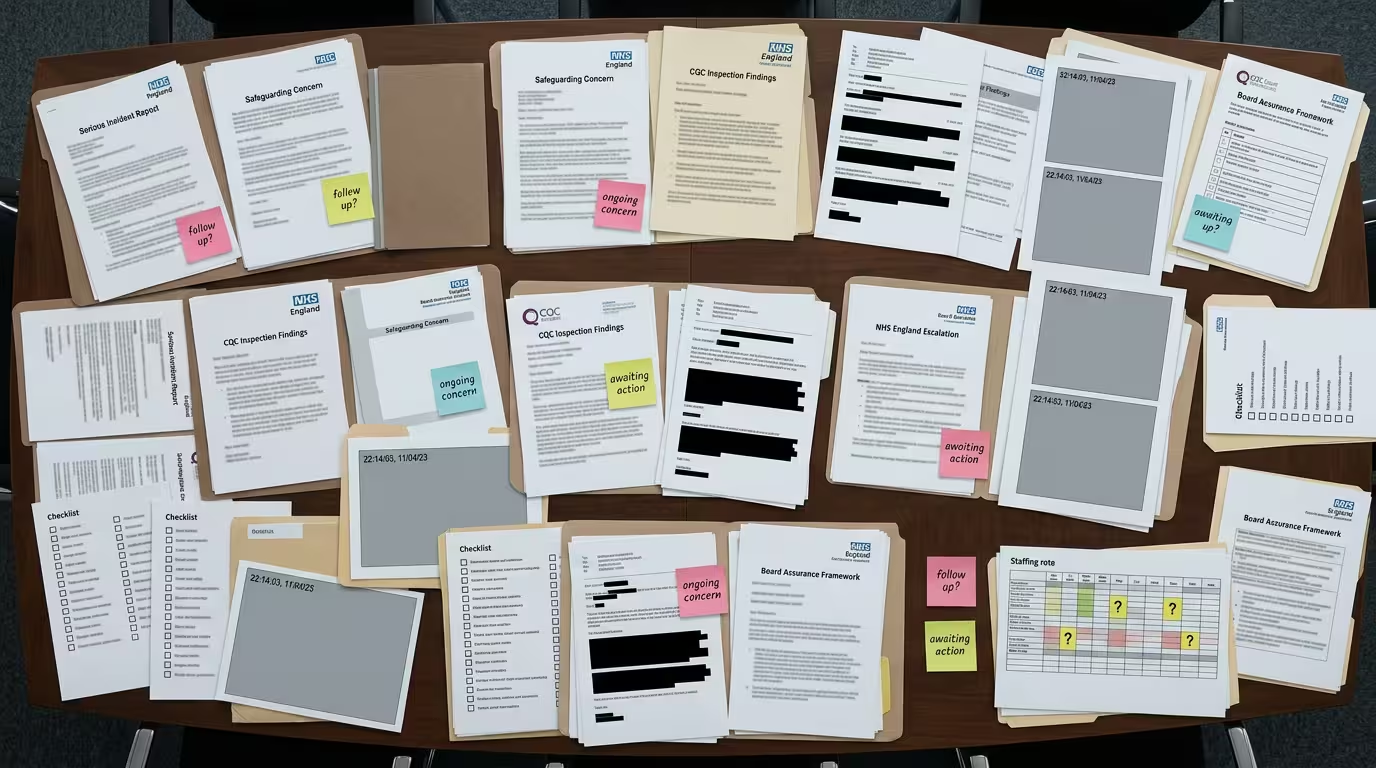
What makes St Andrew’s analytically useful is that several governance signals were visible in public regulatory material at the same time.
- limited board level assurance rather than strong and consistent confidence in the organisation’s governance arrangements
- weak use of performance data for interpretation, assurance, and decision support
- leadership instability including repeated turnover in executive nurse leadership
- staffing fragility and continuing dependence on non permanent staffing arrangements
- closed culture concerns affecting morale, speaking up, and the organisation’s ability to surface and act on risk
- difficulty embedding improvement even after repeated regulatory findings and enforcement action
None of these signals on its own automatically proves organisational failure. Together, however, they point to a system struggling to convert warning into reliable protection.
Why provider replaceability matters
This case also highlights a deeper structural problem. Oversight becomes more difficult when the provider sits in a part of the system that is harder to replace.
NHS England’s own enforcement language refers to the standards expected of a hard to replace provider. That matters because specialist capacity is not easily reproduced elsewhere. Where the patients are complex, the placements limited, and the alternatives scarce, the system cannot simply switch providers without causing further disruption and risk.
That creates a difficult tension. The more specialised and difficult to replace the provider is, the more careful the system may become about large scale intervention. But that same structural difficulty may also allow weaknesses to persist for longer than they should.
What this case reveals about escalation architecture
The deeper lesson here is not only that St Andrew’s failed. It is that the surrounding oversight system appears to have taken too long to translate repeated concern into protective action.
That is an escalation architecture problem.
It raises questions such as:
- When should repeated warning trigger a different level of intervention?
- Who owns the decision to move from monitoring to protection?
- What level of recurring concern should be enough in high vulnerability environments?
- How should oversight work when replacing the provider is itself difficult and risky?
These are not abstract governance questions. They shape whether warning remains information, or becomes action in time to reduce harm.
Final reflection
St Andrew’s Northampton matters beyond one organisation because it shows what can happen when serious concern becomes recurrent, but still does not convert quickly enough into protection.
If a system only moves decisively once hundreds of patients may need to be relocated, that is not simply an institutional failure. It is a failure in the way warning, assurance, escalation, and protective decision are connected.
And that is why this case should not only be read as a scandal. It should be read as a governance pattern.
Pass on the canonical article link in the format people already use.
Get alerts on this device when new writing lands.
Turn on browser notifications for fresh articles and high-signal editorial drops. On iPhone or iPad, install the app to the Home Screen first.
No inbox clutter. This browser or installed web app becomes the endpoint.
Recommended next step
Want this applied to a live provider context?
Pattern Scope turns public-source review into a structured outside-in reading for decision-makers who need to know where to look more closely.